
Building a Dementia-Friendly Community
November is Alzheimer’s Awareness Month. By raising awareness, we can educate families navigating this illness and build a community that knows how to support them. Even if you aren’t personally affected by Alzheimer’s or another form of dementia, please read on. Every one of us who learns a little more brings our community one step closer to being dementia-friendly.
Understanding Alzheimer’s and Dementia
Dementia describes a group of symptoms that affect memory, thinking, and social abilities, eventually interfering with daily life. It isn’t one specific disease. It’s an umbrella term for the symptoms caused by many different brain diseases. Alzheimer’s is the most common form of dementia in older adults, but there are many others.
Dementia occurs when damage to brain cells interferes with their ability to communicate with one another. When that communication breaks down, thinking, behavior, and feelings can all be affected.
Early warning signs, and what’s typical by comparison:
Memory loss that disrupts daily activities. Typical aging: Occasionally forgetting names or appointments, but remembering them later.
Challenges in planning or problem-solving. Typical aging: Making an occasional error when managing finances or household bills.
Difficulty completing familiar tasks. Typical aging: Occasionally needing help with microwave settings or recording a TV show.
Confusion with time or place. Typical aging: Forgetting the day of the week but figuring it out later.
Trouble understanding visual images and spatial relationships. Typical aging: Vision changes related to cataracts.
New problems with words in speaking or writing. Typical aging: Sometimes struggling to find the right word.
Misplacing things and losing the ability to retrace steps. Typical aging: Misplacing things from time to time, then retracing your steps to find them.
Decreased or poor judgment. Typical aging: Making a bad decision once in a while, like forgetting to change the oil in the car.
Withdrawal from work or social activities. Typical aging: Sometimes feeling uninterested in family or social obligations.
Changes in mood or personality. Typical aging: Having set ways of doing things and becoming irritable when a routine is disrupted.
Source: 10 Early Signs and Symptoms of Alzheimer’s & Dementia, Alzheimer’s Association
Supporting Someone Living with Dementia
Focus on the person and the present moment rather than on lost abilities or memories. Instead of asking, “Do you remember?”, ask how they’re feeling today. It also helps to stay attuned to their changing needs, build in structured routines, and find new ways to stay connected.
Every spring and fall, Methow At Home hosts Caring for People Living With Dementia, a four-part workshop series. If you’re navigating dementia with a loved one, it’s a great way to learn care strategies and find support. Volunteers from our Creative Aging program join each session to offer your loved one a supervised, dementia-friendly arts program while you attend.
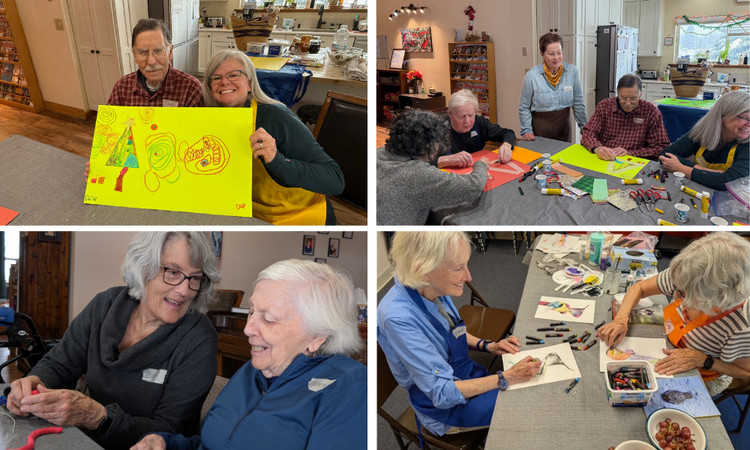
Snapshots from Methow At Home’s Creative Aging Program
Supporting Caregivers
Caring for someone with dementia at home often transforms family dynamics. A son or daughter may become a parent’s caregiver, or a spouse may take on full-time care. Most family caregivers have no training. They simply step up. And because they rarely have time or energy to spare, they often neglect their own needs.
If you know a caregiver, find a way to support them. Drop off a meal or offer to stay with their loved one for a few hours so they can step away.
Methow At Home members can request volunteers for these much-needed breaks. Our social respite care volunteers provide a four-hour caregiving shift up to twice a week, so the loved one is cared for while the caregiver takes time for themselves. To receive this service or to volunteer as a respite caregiver, please contact Laura at Laura@methowathome.org.
Building a Dementia-Friendly Community
Behavior that deviates from social norms can create stigma around dementia and the people living with it. Becoming a dementia-friendly community starts with understanding and awareness. When the public knows how to interact with people living with dementia, our community becomes more welcoming and inclusive. In practice, that means creating social and cultural spaces where people living with dementia feel they belong.
Resources for Families
If your loved one is navigating dementia, we hope you’ll find support that feels meaningful to you. Methow At Home has compiled a local guide full of helpful information and resources. We also offer free workshops, a dementia-friendly art program, and, for members, social respite care twice a week. Reach us at 509-996-5844.
The Alzheimer’s Association also offers a wealth of resources and a 24/7 Helpline at 800-272-3900. Even if you aren’t certain what to ask, give them a call and they’ll guide you from there.
Next Steps
Awareness builds a more supportive community, and every step you take today helps ensure support will be there if you ever need it. No family should have to navigate a dementia diagnosis alone, and Methow At Home is working to provide the awareness, programs, resources, and volunteers to make that true.
Four ways to get involved this month:
Explore online resources to learn more about symptoms and caregiving approaches.
Share this information with friends and family.
Become a social respite care volunteer with Methow At Home.